Effortless Business Automated by Intelligence
Welcome to Datacybornetics—join us to master AI automation & boost productivity!
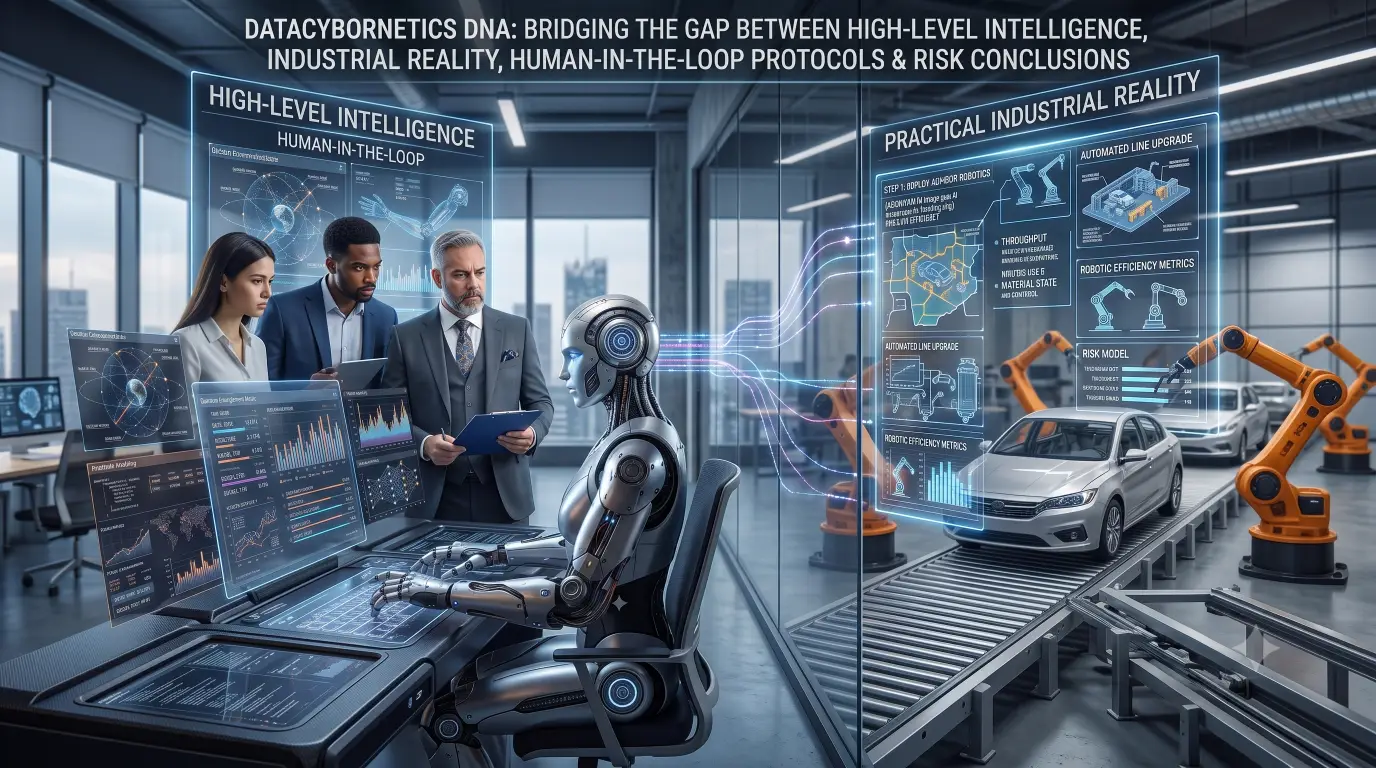
Datacybornetics DNA
Bridging the gap between high-level intelligence, practical industrial reality, Human-in-the-loop protocols & risk conclusions
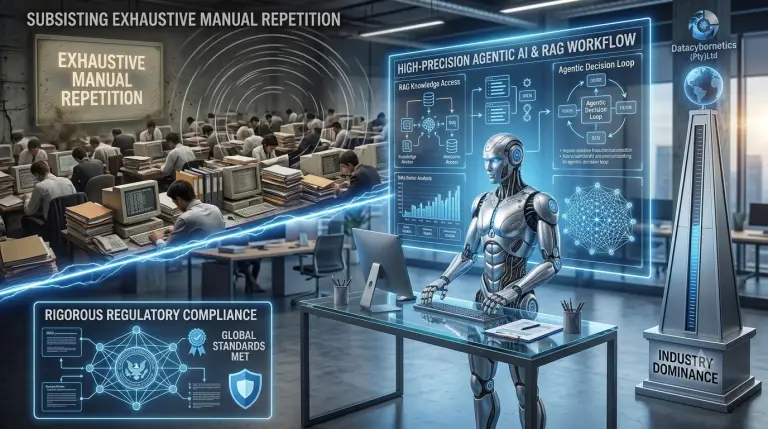
Core Industrial Mission
Datacybornetics substitutes exhaustive manual repetition with high-precision Agentic AI and Retrieval-Augmented Generation (RAG). Ensure rigorous regulatory compliance and secure absolute dominance within the industry.
Empower your people with AI, rather than replacing them with it.
AI Training and Enablement Programs: Bespoke workshops designed to equip personnel with the requisite skills to master AI tools and optimize human-AI collaboration.
Datacybornetics is founded upon the application of artificial intelligence to resolve tangible business challenges. Our client-centric methodology ensures the delivery of bespoke solutions that integrate seamlessly into existing workflows, whilst our commitment to professional training ensures that AI serves to augment human capability rather than supersede it.
AI Spending to Grow 47% in 2026
Worldwide spending on AI is forecast to total $2.59 trillion in 2026, a 47% increase year-over-year, according to Gartner, Inc. a business and technology insights company.

Are you ready for the pivotal shifts?
Accelerated AI Adoption: Whilst a vast majority of enterprises anticipate that AI will transform their operations, actual outcomes frequently fall short of expectations, intensifying the demand for candid, expert guidance.
Prioritisation of Productivity: Modern businesses increasingly leverage AI to optimize human capital, enabling personnel to execute tasks with greater strategic intelligence rather than increased exertion.
Demand for Bespoke Solutions: Standard, off-the-shelf software consistently fails to address idiosyncratic business constraints, thereby driving the requirement for custom AI automation engineering.
Imperative for Workforce Upskilling: Organizations widely acknowledge that successful integration depends upon comprehensive employee training to weave AI seamlessly into daily workflows.
AI as a Competitive Lever: Beyond mere operational efficiency, forward-thinking enterprises deploy artificial intelligence as a core strategic instrument to secure market dominance.
Simple steps to starting your AI automation journey
1. Audit and Identify Bottlenecks
Conduct a meticulous audit of existing operational workflows. Isolate tasks characterised by high repetition, predictable logic, and significant time expenditure—such as manual data entry, client onboarding administration, or invoice processing.
2. Select and Deploy the Right Tooling
Match technology to the problem. Begin with specialized AI tools or automation platforms. Integrate these Datacybornetics tools into your workflow to automate the prioritized task.
3. Train Staff and Iterate
Manage change and scale. Train your team to work alongside the new automated systems, shifting their focus to higher-value activities. Monitor the automation's accuracy and efficiency metrics, then use those insights to refine the system before expanding to the next workflow.
4. The Golden Rule of Automation
Automating an inefficient process only accelerates inefficiency. We recommend optimising your manual workflows before deploying Datacybornetics to scale production. To evaluate your current infrastructure, our AI Audit Report assesses your business's immediate readiness for automation.
Should AI automation be on your immediate operational roadmap?
We turn AI curiosity into company capability - assessing where you are today and engineering where you need to be tomorrow.




The DARK side of AI
A 2026 survey of over 230 security leaders highlights that AI systems are operating with ungranted high-level access and non-human activity patterns, leaving security teams struggling to answer fundamental questions about who initiated an action and whether it should have been authorised.
Ungoverned Access: 71% of CISO report AI agents have access to core business systems, yet only 16% govern that access effectively.
Severe Lack of Visibility: Over 90% of organisations lack full visibility into AI identities and doubt they could detect misuse.
Enforcement & Containment Deficits: 86% do not enforce access policies for AI identities, and only 5% feel confident they could contain a compromised AI agent.
Unsanctioned AI Use: 75% of organisations have discovered unmonitored, unsanctioned AI tools running with embedded credentials or elevated access.
Outdated Tools: Only 25% use AI-specific controls; most rely on legacy security tools designed for human workflows rather than autonomous agents.
You may read the full, highly insightful article via the provided link.

Global competitiveness requires reliable, sustainable AI infrastructure. South African enterprises achieve this through operational optimisation and workforce readiness.